








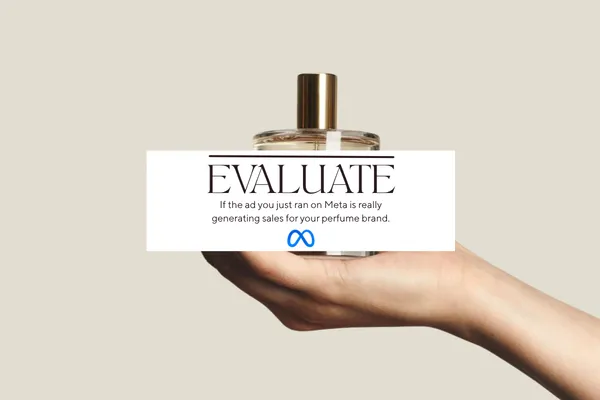
Learn How to Evaluate Perfume Meta Ads
You're Killing Your Perfume Ads at Exactly the Wrong Moment
Most perfume brands pull their ads too early. A few keep them running too long. Almost none of them know which mistake they're making.
I know that sounds like a setup. Bear with me.
I was working with a fragrance brand — mid-range positioning, $80–$120 bottles, decent product photography, Instagram-native aesthetic. They were running about six creatives at once, and every two or three days, someone on the team would flag an ad that "wasn't performing." We'd kill it. Launch something new. Kill that too. The account was churning creatives constantly, and the CPA wasn't moving.
The problem wasn't the ads. It was that nobody had defined what failure actually looked like before we launched.
That's the thing about the perfume space specifically. You're selling a sensory product through a visual medium. The creative has to do heavy lifting — it needs to evoke scent through imagery, lifestyle, emotion. That takes more than two days and forty dollars to figure out.
Set the Benchmark Before You Spend a Dollar
Before any creative goes live, you need to decide what success and failure look like for that specific ad at that specific stage. Not in general — for this ad, this goal, this week.
If you're running a top-of-funnel creative meant to introduce your fragrance brand to cold audiences, you're not measuring CPA on day three. You're watching hook rate, thumb-stop ratio, and video completion. If you're running a direct-response ad with a first-order offer — 20% off your first bottle, free shipping on two — then CPA is exactly what you're measuring.
Perfume brands collapse these two modes constantly. They run brand-feel content and panic when it doesn't convert. They run conversion ads and wonder why brand affinity isn't building. Decide what the ad is for. Then measure that thing.
The $100 Rule — What It Actually Means for Fragrance
For any individual creative, spend around $100 before making a call. That's roughly $5 a day over two weeks. It's not arbitrary — it gives Meta's algorithm enough data to exit the learning phase and find the right people inside your audience.
After $100, your creative lands in one of three places. It's clearly failing: weak CTR, high CPA, no engagement signal worth noting. Cut it. Don't negotiate. Don't give it another week because the photography was expensive. Cut it. Or it's performing — hitting your CPA target, generating add-to-carts, showing ROAS above your threshold. Keep it running and immediately start building variations off what's working. The third outcome is mediocre. This one is where perfume brands get tripped up.
Mediocre doesn't mean dead. In a category where the hook has to evoke smell through a static image or a 15-second video, mediocre sometimes means the creative concept is right but the execution missed slightly. Maybe the visual is pulling the click but the product page isn't converting. Maybe the hook is weak but the offer is strong. Before you kill a mediocre ad, ask: is the problem the ad, or something downstream from it?
What Mediocre Is Actually Telling You
A mediocre perfume ad usually has something working. Your job is to find it.
If CTR is decent but conversion rate is low, the problem is likely your landing page, not your creative. Are you landing cold traffic on a homepage? On a collection page? Send them to a single-product page with a clear offer, strong sensory copy, and social proof. A Meta ad for a perfume brand should land on something that continues the emotional job the ad started.
If CTR is low but you're getting some conversions from the traffic that does click, the hook isn't pulling enough people in. Test new opening frames. The scent-reveal angle works well here — tease the experience before you name the product. "The perfume that makes people stop and ask what you're wearing" outperforms "Shop our new collection" every time on cold traffic.
Don't let mediocre run indefinitely. Give it the full testing window. Evaluate honestly. If there's no upward signal, move on.
The Three Levels You're Actually Testing
Here's where most fragrance brands leave serious money on the table. Individual creatives are just one layer of what you're evaluating.
Above the creative, you're testing messages — meaning the specific emotional angle or problem your ad speaks to. Longevity. Compliment-getting. Seasonal mood. Luxury self-gifting. Gender-forward identity. Each of these is a distinct message, and each one needs around $1,000 in spend across multiple creative executions before you can say the message doesn't resonate. One $100 creative that flopped doesn't tell you the longevity angle is wrong. It tells you that execution didn't land. Run three or four different creatives against the same message before you draw conclusions.
Above the message, you're testing your ICP — the specific buyer you're targeting. The person who buys perfume as a daily ritual is a different person than the one who buys it as a gift, and a different person still from the one who discovers fragrance as a hobby. Each ICP needs roughly $10,000 in spend before you remove it from your strategy. Audiences are complex. The algorithm needs time to find the right people inside a broad segment. Cutting an ICP after one campaign is almost always a mistake. You haven't tested it. You've barely touched it.
Creative Fatigue vs. Creative Failure — Know the Difference
This is the most expensive mistake in fragrance advertising, and it's everywhere.
Creative fatigue is when an ad that worked stops working because the audience has seen it too many times. Frequency climbs, CTR drops, CPA rises. This is normal. It doesn't mean the format failed — it means the audience is saturated. The fix is to rotate in new creative built off the same winning structure.
Creative failure is when an ad never found traction at all. Low engagement from the start, no conversions, nothing in the data suggesting any part of it resonated.
Perfume brands confuse these constantly. A lifestyle video that drove strong ROAS for eight weeks starts fading, and the team concludes "video doesn't work for us." Wrong. Video worked exceptionally well. It just ran its course. Build more videos with similar hooks, similar visual language, similar offer framing. Don't abandon the format because one execution fatigued.
The cost of conflating fatigue and failure is real: you discard proven creative formats while also letting failed ads drain budget too long. It's the worst of both outcomes.
What to Launch, Test, and Scale
Start with three to five creatives testing different angles against the same cold audience. Longevity. Compliment-getting. Unboxing and sensory reveal. Seasonal identity. Gift occasion. Give each one $100 over two weeks.
Cut the clear failures immediately. Let the mediocre ones finish their testing window before deciding. Take the performers and build variations — new hooks, same offer structure. New visual format, same message. Test those variations and find the second-order winners.
Once you have two or three creatives consistently hitting your CPA target, that's when you scale spend. Not before. Scaling a mediocre ad doesn't fix it — it amplifies whatever's wrong with it. Scale only what's already working.
Track the metrics that actually matter at each stage: hook rate and video completion for top-of-funnel creative, CTR and landing page conversion rate for mid-funnel, CPA and ROAS for direct response. Each metric is a diagnostic. Learn to read them as a system, not in isolation.
The Only Goal That Matters
Predictable customer acquisition. That's it.
Perfume is a repeat-purchase category. Customers who love a scent come back. They buy gifts. They try new releases. Your LTV is strong if you get the first order right. That means your Meta ads need to be a system — one that generates first purchases at a CPA you can afford, then feeds repeat behavior through retargeting and email.
The question was never really "should I kill this ad?" The real question is: what is this data telling me, and how do I use it to build something that works at scale? Define success before you launch. Spend what the test requires. Read the data honestly. Build off what works.
That's the whole thing.